For the pediatric DC who is serious about this work. Whether you’re building cranial adjusting into your practice for the first time or you’ve trained before and the harder cases still aren’t moving, this is where the foundation gets built correctly.
The training covers the technique drilled to automatic, the exam that finds the specific subluxation, and the practice economics that make delivering this work sustainable.
Upcoming programs
Plans change. If you cannot make a weekend, roll it to the next program.
-
Level 1 09-26-2026 to 09-27-2026Level 2 03-06-2027 to 03-07-2027Venue Absolute Chiropractic, Wall Township, NJSold out
-
Level 1 01-09-2027 to 01-10-2027Level 2 06-05-2027 to 06-06-2027Venue Wall Township, NJSold out
January is sold out. Next program dates coming soon. Get on the list and you will hear first when they open.
01
The technique
Cranial work breaks down at home for one reason: nobody is watching your hands. You leave a weekend knowing something was there, then you cannot find it again on a dysregulated two-year-old. The fix is not more technique. It is a framework that tells you what you are looking at, in what order, and what to do about it.
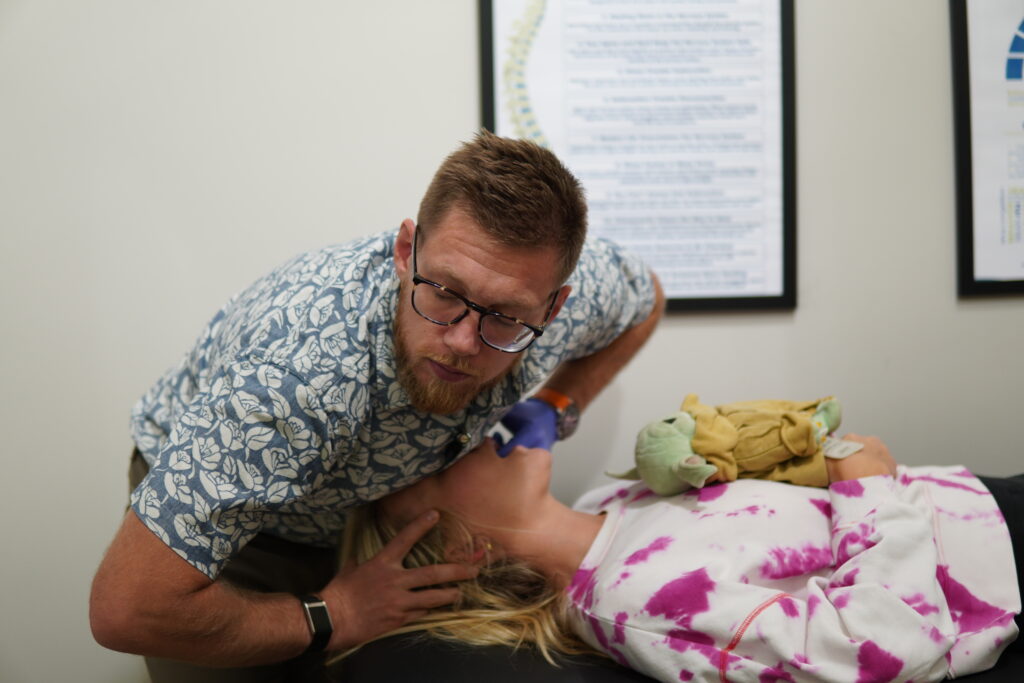
Level 1 builds that from zero: the anatomy, the palpation flow, and a complete light-force correction sequence for all six cranial bones. It gives you the Monday Sequence, a repeatable approach you can run on any patient, any visit, the week you start. You arrive having already worked the online course and practiced on real people, so the weekend corrects your hands under direct supervision until the sequence runs without you narrating it. You leave Level 1 with hands that work Monday morning.
Level 2 takes the correction from general to specific. Instead of broad facilitation, you work the exact subluxation pattern in front of you: the precise correction for that presentation, why it matters for that patient, and how to deliver it. You drill the pattern to correction until it is automatic too. You stop hoping a cranial case responds and start running it on purpose.
02
The exam
You analyze for the specific subluxation that calls for a specific adjustment, in a specific vector, with a specific force, at a specific time. Level 1 builds that foundation, training you to analyze the cranium and find what is actually there instead of working in generalities.
Level 2 takes the analysis to the pattern. You learn to read the cranium and see not just that something is off, but exactly what it is and where it sits. That is the difference between a doc who facilitates and a doc who has the confidence and authority to know exactly what the child needs and deliver exactly that, with precision.
The four measurements I take at every infant head-shape exam run through the cranial measurement calculator.
03
The practice economics
Plenty of chiropractors will work a cranial case. Very few work it at the level this builds. When you can examine, communicate, and deliver results, you stop being an option compared on convenience and copay and become the one they were told to find.
Level 2 builds the communication and business side of that. You learn the Day 1 and Day 2 framework for the consultation and report of findings: how to present what you found, build the value of the work, and structure a care plan a family says yes to, at a high value of care. Not a script to recite, the method, so you can run it in your own practice. It is the same fluency that makes lactation consultants, pediatricians, and ENTs start sending you the cases they have nowhere else to send.
All of it points at one thing: a practice you have structured on purpose, around the life you actually want to live, instead of someone else’s dream running inside your office.
04
How it’s structured
This is a two-level system, and each level is the same shape: an online course you work through on your own, then a hands-on intensive that locks it in. The online content comes first. By the time you reach the weekend you have already worked the material and practiced on real people, so you know exactly where you are breaking down. The intensive fixes that, under direct supervision.
The two intensives sit roughly six months apart. In between, you keep refining Level 1 on real cases and work through the Level 2 online material, which runs deep, step by step, with Q&As along the way.
Seats are limited. Hands-on drilling time is the limiting factor, and every doctor in the room gets their share of it.
For: Pediatric DCs. No prior cranial training needed.
Not for you if you want a weekend certificate, or won’t put your hands on real patients between intensives.
Questions
Where can a chiropractor learn pediatric cranial adjusting?
At The Cranial Doc training, taught by Dr. Anthony Pellegrino, DC, a practicing pediatric chiropractor and craniopath. It runs in two levels. Each level is an online course with live Q&A calls, followed by a hands-on weekend intensive on the Jersey Shore.
Level 1 works through the cranium one structure at a time (occiput, sphenoid, temporals, parietals, frontal, maxilla) and ends in the Monday Sequence, a complete light-force correction sequence you can run on any patient the week you get home. Level 2 takes you from general to specific: the specific correction for each subluxation pattern, the complete exam, measurements, and the report of findings that walks a family through what you found.
What cranial chiropractic training is there for practicing chiropractors?
The Cranial Doc runs a two-level program for chiropractors who already see kids. Level 1 is the technique: the anatomy, the palpation flow and a light-force correction sequence for the whole cranium, drilled under supervision until it runs without you narrating it. Level 2 is the specific subluxation pattern, the exam that finds it, and the consultation and care plan a family says yes to. Each level is an online course with live Q&A calls, then a two-day intensive on the Jersey Shore. The next program's dates are at the top of this page.
Is a lighter touch always better in pediatric cranial adjusting?
No. Lighter isn't the goal. Specific is.
Cranial work uses four levels of force, and each one accesses something different:
- Lightest, under five grams, for CSF flow.
- Mild, for the membranes: dural and meningeal tension.
- Moderate, for secondary respiratory motion.
- Heaviest, for suture mobility and specific subluxation correction.
You choose the level by what you are correcting.
Facilitating CSF flow in a system that is already moving is so light the patient barely feels you touching them. In an adult, a sphenomaxillary correction, unhooking the vomer and sphenoid, takes real pressure, and the patient feels it. Work at only one level, light or heavy, and you miss every correction that lives at another one.
That is craniopathy: a specific correction of a specific subluxation, in a specific vector, with a specific force, at a specific time.
On a baby, even the heaviest level is about the pressure you would use to check a ripe fruit or put in a contact lens.
Ready to build this in?
Dates and pricing for each program are at the top of this page.